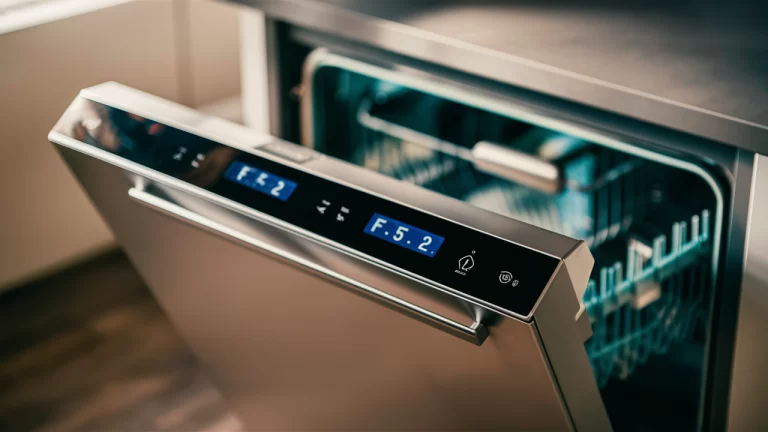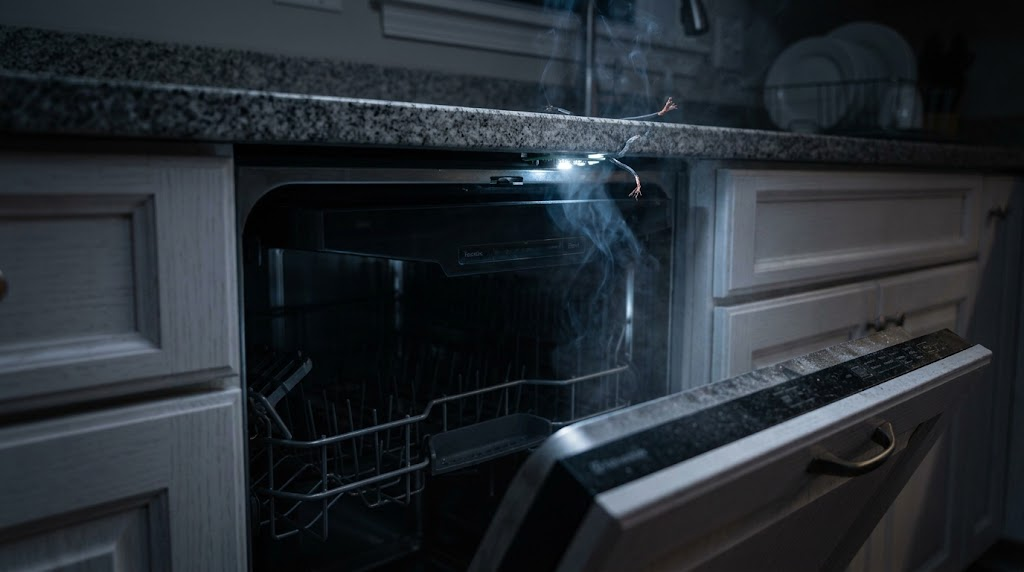
Open the dishwasher, press start, and get nothing at all? No lights, no hum, no response? A completely dead dishwasher is almost always a power-delivery problem, and most of the checks are quick and safe to do yourself.
Here is how to trace the power from the wall to the control board and fix what is breaking the path.
This article will teach you:
- The most common reasons a dishwasher loses power
- How to check the breaker, GFCI, and outlet
- Why the door latch can cut all power
- When wiring or the control board is the culprit
Why a Dishwasher Loses Power
Ever notice the kitchen outlets nearby went dead at the same time? That is a clue. The usual causes of a no-power dishwasher are:
- A tripped breaker or blown fuse at the panel.
- A tripped GFCI outlet that feeds the dishwasher circuit.
- A faulty door latch or switch – the dishwasher will not power its cycle unless it senses the door is latched.
- A loose or burnt wire connection at the junction box under the unit.
- A failed thermal fuse or control board inside the door.
What You’ll Need
- A flashlight
- A screwdriver
- A multimeter, for testing the latch switch or fuse
Safety First
- Switch off the dishwasher breaker before opening any panel or junction box.
- Confirm the power is off with a tester before touching wires.
How to Diagnose No Power
Ready? Work from the wall inward.
- Check the breaker and fuse. Reset a tripped breaker or replace a blown fuse at the panel.
- Reset the GFCI. Press reset on any GFCI outlet on that circuit, often near the sink.
- Test the outlet (for plug-in models) with another device or a tester.
- Check the door latch. Make sure the door closes fully and the latch clicks. Test the latch switch for continuity and replace it if it fails.
- Inspect the wiring. With power off, open the junction box under the dishwasher and tighten or repair any loose or scorched connections.
- Test the thermal fuse on the control board for continuity if everything upstream checks out.
Pro Tip: Try the door latch early. A worn latch switch is a common reason a dishwasher that has power at the outlet still acts completely dead.
When to Look a Little Deeper
If the outlet is fine, the supply itself may be the issue, and it helps to understand power cord versus hardwired dishwasher connections or to replace a damaged power cord. When power reaches the unit but it stays dead, the board is the likely failure, the same swap shown in the LG dishwasher control board replacement.
If the dishwasher does have power but the buttons will not respond, that is a different fix, covered in a control panel that is not working. And if it powers on but stops partway with an error, work through a code such as the GE F33 error.
When to Call a Pro
If the breaker, GFCI, outlet, latch, and wiring all check out and the unit is still dead, an electrician or appliance tech should verify the board and the circuit before further work.
Related guides
- Dishwasher Leaves Grit on Glasses: Find and Fix the Cause
- GE Dishwasher Door Interlock Switch Replacement: A Quick DIY Guide
Wrapping Up
A dead dishwasher is usually a broken power path, not a broken machine. Here’s the short version:
- Reset the breaker and any GFCI outlet.
- Confirm the outlet has power.
- Check the door latch and its switch.
- Tighten wiring and test the thermal fuse before replacing the board.
Start at the breaker and work inward, and you will usually find it fast. You’ve got this.
When the test points to the part, shop dishwasher door latch parts for your model and confirm the fit with the full model number before ordering.