Frozen fresh food can point to an incorrect temperature setting or uneven airflow. It can also call for a closer look at the refrigerator’s temperature controls. The symptom alone does not identify a failed part. A useful diagnosis separates a problem with food placement from a fault that affects the whole compartment.
The question “Why is my refrigerator freezing everything?” deserves a clear answer before money goes toward a replacement. This guide explains what the evidence can support, which early checks are practical, and when a model-specific diagnosis becomes necessary.
What This Symptom or Part Can and Cannot Prove
These distinctions help keep a symptom from becoming an unsupported diagnosis.
- Frozen food confirms a storage problem, but does not identify its electrical cause.
- Freezing concentrated near an air outlet makes food placement relevant.
- A cold-control thermostat and a temperature sensor are different components.
- A part listed for a similar refrigerator may still be incompatible.
- A replacement recommended for another household does not establish the cause in this appliance.
The useful question is whether the available evidence supports the proposed repair. A parts list can show what the refrigerator contains. It cannot show which component has failed today. That decision needs a result tied to the actual model, rather than a guess based on the title of a troubleshooting article.
Verify Your Model First
Find the refrigerator model tag before ordering. Record the full model number, including its suffix, because parts with the same name can use different connectors, dimensions, ratings or mounting points across models.
Possible tag locations include the following areas.
- An inside compartment side wall.
- The refrigerator’s face frame.
- The area behind the lower crisper drawer.
- The area behind the lower toe plate.
The model-number locator shows possible locations. The serial number identifies the individual appliance; it should remain separate from the model number in a parts inquiry. A clear photograph reduces the chance of mistaking a letter for a number.
Compatibility has two parts. The replacement must belong to the refrigerator’s parts diagram, and it must address the fault that the diagnosis actually found. A correct fit without a correct diagnosis can still leave the freezing problem unresolved.
Safety Before Testing
- Disconnect power and confirm the appliance is de-energized before internal work.
- Follow local electrical requirements.
- Leave household wiring and outlet work to a licensed electrician.
- Do not use continuity mode as a substitute for a thermistor resistance test.
- Leave control-board diagnosis to someone with the correct service information.
Causes to Check Before Buying a Part
Use this table to separate preliminary evidence from a confirmed component failure.
| Cause | Evidence | Safe Check | What the Result Means |
|---|---|---|---|
| Temperature setting | The selected temperature is below the recommended value | The control-setting sequence below | A setting issue may explain the symptom without a replacement |
| Food near an air outlet | Freezing is concentrated in that location | The appliance manual’s storage guidance | Local freezing does not establish a failed thermostat |
| Cold-control fault | The problem remains after basic corrections | Model-specific professional diagnosis | A compatible control becomes relevant only after confirmation |
| Another temperature-control issue | The diagnosis points beyond the basic setting | The exact model’s service information | Further testing is needed before selecting a part |
Once the test identifies the failed part, confirm the exact replacement with the full model number. For a confirmed cold-control failure, compare refrigerator temperature controls.
Safe Testing and Repair Order
Rule Out Temperature-Setting Causes
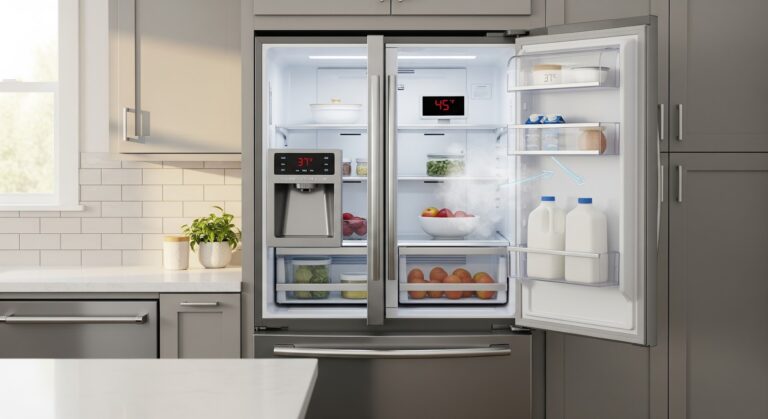
- Locate the temperature dial or digital control inside the refrigerator.
- If the setting is below 37°F, raise it.
- Allow 24 hours for stabilization before checking whether freezing continues.
This preliminary sequence comes from the assigned freezing-food procedure. Exact control operation depends on the appliance manual.
Follow the Model-Specific Procedure
Internal tests require the service instructions for the actual refrigerator. This guide does not supply a universal meter reading or a universal removal sequence. A thermostat test for one design should not be treated as a sensor test for another.
For a repair estimate, the most useful supporting information is specific.
- The complete model number.
- The location of the frozen food.
- The selected temperature setting.
- The result after the stabilization period.
- Any displayed fault code.
These details help define the problem without assuming its cause. A technician can then explain which observation or measurement supports a replacement recommendation. That explanation matters more than the number of possible parts on a shopping page.
Interpret the Result
A setting correction that resolves the problem gives no reason to buy a control. Persistent freezing justifies further investigation, but still does not prove a specific component has failed. A parts recommendation should identify the failed component and the evidence used to reach that conclusion.
Test result confirmed a cold-control failure? Find the exact temperature control for this model number.
How to Identify the Correct Replacement for This Model
The temperature-control category contains different replacements. Its presence does not mean that every refrigerator uses the same control.
Useful compatibility evidence includes the following details.
- A model-specific parts listing.
- The replacement manufacturer’s part number.
- The correct location in the parts diagram.
- A documented replacement number when the original has changed.
A photograph is useful context, but appearance alone is weak evidence of fit. Keep the diagnosis and compatibility decision together in the repair record. This helps prevent an order from drifting toward a visually similar item that was never specified for the appliance.
When to Stop and Call a Professional
Further help is appropriate in these situations.
- Internal testing requires unfamiliar meter work.
- The service information does not match the appliance.
- The diagnosis points to a control board.
- There is electrical damage.
- The freezing problem persists without a clear explanation.
The decision to stop can save the cost of an unnecessary part. It also gives the repairer a chance to check the complete system rather than working backward from a purchase already made.
FAQ
What should be checked first before buying a replacement?
The temperature setting is the first check covered here. The symptom should be described by location and persistence before a part is selected.
How can a bad part be distinguished from a setting issue?
A setting issue may resolve after the supported adjustment and wait. A component diagnosis needs additional model-specific evidence.
What result confirms a failed replacement part?
There is no universal reading for all possible parts. The result must match the test and specification for the component in the exact refrigerator.
Where is the model number, and why does the suffix matter?
An inside side-wall label is one possible location. Other locations vary by design. The full suffix helps distinguish versions that may use different replacements.
When should troubleshooting stop?
Stop when the next test exceeds the available instructions or the person’s experience. Persistent freezing without a confirmed cause calls for professional diagnosis.
In Summary
Food freezing in the fresh-food compartment deserves attention, but a symptom should not decide a parts order. Basic setting evidence can narrow the next step. A confirmed diagnosis makes replacement selection more useful.
After a technician confirms a cold-control failure, find the correct temperature control for your model to compare compatible replacements before ordering.