Refrigerator vegetables freezing in crisper drawer storage can mean too much cold air reaches the produce. The drawer may sit in a cold spot. The rest of the fresh-food section can still feel normal. A low setting can cause the problem. A blocked vent, crowded shelf, or wrong drawer setting can also change airflow.
Frozen produce often becomes soft after it thaws. Fixing the cause can protect the next grocery load. It may also reveal a wider refrigerator temperature problem. Start with a thermometer and simple storage changes. Consider a bad sensor, damper, or control only after those checks.
Quick diagnosis table
Take the thermometer reading before touching any part, because settings and airflow cause most of these.
| Symptom detail | Likely cause | What to check | Fix or part |
|---|---|---|---|
| Produce freezes, shelves feel normal | Control set too cold | Thermometer in glass of water on middle shelf | Move setting one step warmer, wait 24 hours |
| Greens frozen against back wall | Produce touching wall near vent | Look for frost near air outlet | Move produce away from rear wall |
| Cold spots after a big grocery trip | Blocked return vent or packed shelves | Check for food covering vents | Space packages so air circulates |
| Vegetables freeze in temperature drawer | Drawer set for meat | Check drawer temperature control | Set drawer to vegetable position |
| Fridge runs constantly, food freezes in many areas | Faulty damper, thermistor or control | Readings stay low after a full day | Technician tests sensor and damper |
| Damper clicks repeatedly | Air damper stuck or faulty | Listen for repeated clicking | Have damper control checked |
Why Refrigerator Vegetables Freeze in the Crisper Drawer
Cold air enters through vents linked to the cooling system. The fan moves that air to keep food cold. Produce can freeze when a cold stream reaches the drawer. It can also freeze when the whole section runs below the set temperature.
Common causes include:
- The refrigerator control is set too cold.
- Produce touches the rear or side wall near an air vent.
- Food blocks a return vent and changes normal airflow.
- Shelves or drawers are packed too tightly.
- A temperature-controlled drawer is set for meat instead of vegetables.
- The crisper drawer is installed in the wrong position.
- A thermistor, air damper, or electronic control has a fault.
- The room around the refrigerator is unusually cold.
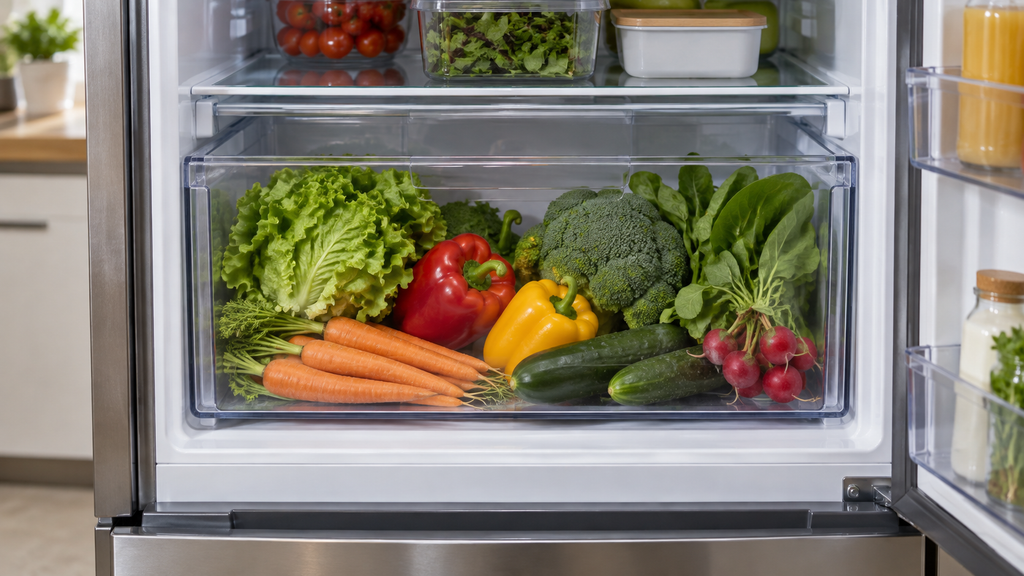
Humidity controls affect moisture inside many crisper drawers. They do not directly set the refrigerator temperature. A high setting closes a small opening. It holds moisture for leafy greens. A low setting opens the vent for fruit and produce with skins.
Confirm That the Refrigerator Is Too Cold
Food can freeze in one drawer while the display shows a normal setting. An appliance thermometer shows the real temperature near the produce.
Useful observations include:
- Note which vegetables freeze and where they sit in the drawer.
- Check whether milk, drinks, or food on nearby shelves also forms ice.
- Look for frost near an air outlet.
- Listen for a fan that runs for very long periods.
- Check whether the refrigerator door closes and seals fully.
- Note any recent control change, power outage, move, or repair.
The fresh-food section should keep perishable food at 40 degrees Fahrenheit or below. Many refrigerators work well near 37 degrees. The right setting and adjustment steps come from the model’s manual.
Food Safety and Refrigerator Checks
- Discard food that has spoiled or developed an unsafe odor.
- Keep perishable food at 40 degrees Fahrenheit or below.
- Do not taste food to decide whether it is safe.
- Use a refrigerator thermometer made for food storage.
- Unplug the refrigerator before removing covers or reaching near a fan.
- Keep air vents clear without removing guards.
- Do not adjust wiring, sealed tubing, or refrigerant parts.
How to Fix Refrigerator Vegetables Freezing in Crisper Drawer Storage
Make one change at a time, then allow the refrigerator enough time to settle. Most manuals recommend waiting about a day after a temperature adjustment before judging the result.
Measure the Fresh-Food Temperature
- Place an appliance thermometer in a glass of water on a middle shelf.
- Keep the glass away from the wall and direct air outlets.
- Leave the refrigerator closed as much as possible for several hours.
- Read the thermometer and compare it with the control setting.
- Repeat the check near the crisper without placing the thermometer against a cold wall.
Adjust the Temperature Setting
- Find the temperature instructions in the owner’s manual.
- Move the fresh-food setting one step warmer when readings are too low.
- Keep perishable-food temperatures at or below 40 degrees Fahrenheit.
- Wait about 24 hours before making another change.
- Record the new reading and check whether produce still freezes.
Restore Airflow Around the Drawer
- Remove food that touches the rear wall or covers an air vent.
- Leave space between packages so air can circulate.
- Push shelves and drawers fully into their correct tracks.
- Confirm that no liner, bag, or container blocks a return opening.
- Place delicate produce away from the coldest rear corner.
- Close the door and check that nothing prevents the gasket from sealing.
Set the Crisper for Produce
- Check whether the drawer has a humidity control or a separate temperature control.
- Set a temperature-controlled drawer to the vegetable position.
- Use high humidity for many leafy vegetables that wilt easily.
- Use low humidity for many fruits and produce with skins.
- Avoid packing the drawer so tightly that its openings are blocked.
- Monitor the next load of produce for several days.
Storage Changes That Reduce Spot Freezing
The coldest area differs by refrigerator design. A few storage changes can protect produce while keeping safe airflow through the cabinet.
- Keep leafy greens away from the rear wall.
- Store produce in the correct crisper rather than a meat or deli drawer.
- Leave room around packages near supply and return vents.
- Keep the drawer partly filled without forcing it shut.
- Use containers or bags recommended for the type of produce.
- Separate ethylene-producing fruit from sensitive vegetables when practical.
- Close the drawer completely after every use.
Do not cover vents with cardboard, tape, or towels. Blocking a vent can create other warm and cold areas and may strain the cooling system.
When a Part May Be Causing the Cold Spot
Repeated freezing after the right settings and storage changes can point to a control problem. The air damper may stay open. A temperature sensor may report the wrong reading. The control board may run cooling longer than needed.
Clues that support professional diagnosis include:
- Thermometer readings stay below the selected range after a full day.
- Food freezes in several areas of the fresh-food compartment.
- A strong stream of cold air continues at the crisper.
- The damper makes repeated clicking sounds.
- The display shows an error code.
- The refrigerator runs almost constantly in normal room conditions.
- Temperature swings continue with the door closed.
Part locations and test values vary by model. Tests near a fan, damper, or control can expose live parts. Leave that work to a qualified technician unless the service guide supports owner testing.
Avoid These Common Responses
Quick reactions can hide the cause or create a food-safety problem. Avoid these mistakes:
- Do not raise the setting so far that other perishable food warms above 40 degrees Fahrenheit.
- Do not cover air vents to stop a cold draft.
- Do not move a crisper into a different slot unless the manual permits it.
- Do not assume the humidity slider controls temperature.
- Do not make several control changes in the same day.
- Do not replace a sensor before checking actual temperatures and airflow.
Found the faulty part? Find the exact damper control for your model number.
Closing Thoughts
Frozen produce often comes from a setting or airflow issue. It can often be fixed without taking the refrigerator apart. Measure the temperature. Move food away from vents. Confirm the drawer setting and wait after each change. These checks protect vegetables while keeping the rest of the compartment safely cold. When readings stay too low or cold air never slows, a technician can test the sensor and damper for the exact model. Careful changes and a simple thermometer usually provide a clear next step.
When the test points to the part, shop refrigerator damper control parts for your model and confirm the fit with the full model number before ordering.