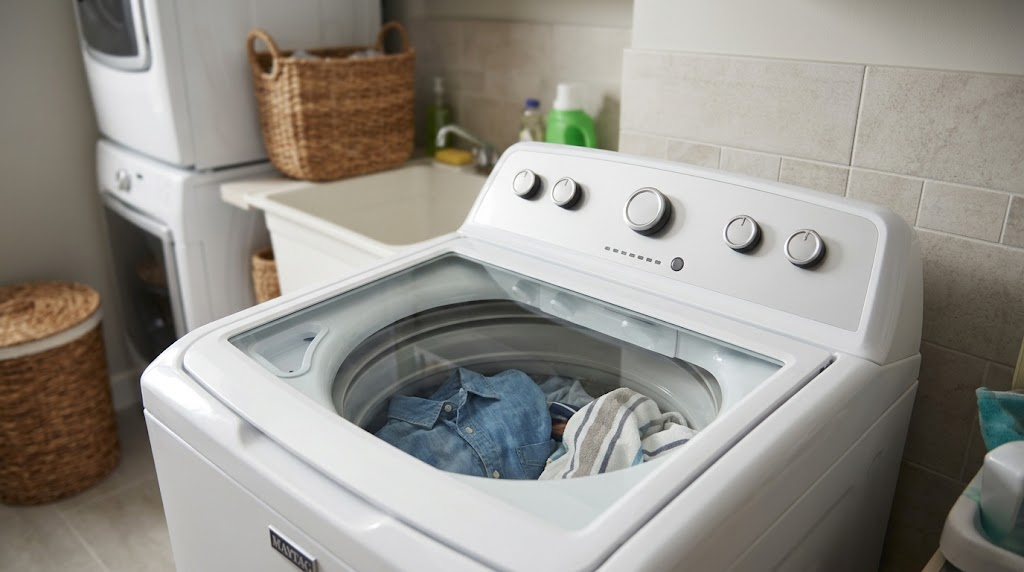
Does your Maytag washer hum or buzz when it should spin, but the tub never gets going? A failed motor capacitor is a common cause. The capacitor gives the motor the jolt it needs to start turning, so when it weakens, the motor strains without spinning up.
This repair is doable at home, but it comes with one important safety step: a capacitor stores an electrical charge even when unplugged, so you must discharge it first. Here is the full, safe process.
In this guide you’ll learn:
- What the motor capacitor does
- The tools to gather first
- How to discharge the capacitor safely
- How to remove and replace it
What the Motor Capacitor Does
The motor capacitor stores and releases energy to give the drive motor a strong starting push. Once the motor is spinning, the capacitor keeps it running smoothly.
As a capacitor ages, it loses its ability to hold a charge. The motor then hums or buzzes but cannot build enough torque to turn the tub. A new capacitor restores that starting punch.
What You’ll Need
- A replacement motor capacitor that matches your model
- A 5/16-inch nut driver
- A 1/4-inch nut driver
- A flat-head screwdriver
Note: Tools vary by model. Check your owner’s manual for the exact fasteners on your machine.
Safety First
- Unplug the washer and shut off the water before you begin.
- Always discharge the capacitor before handling it, as covered in the steps below.
- Hold the screwdriver by its insulated handle only, never the metal shaft.
How to Replace the Motor Capacitor
Ready? Follow these steps in order, and do not skip the discharge step.
- Unplug the washer, shut off the water, and lean the machine back.
- Remove the belt shield bolts with the 5/16-inch nut driver and set the shield aside.
- Disconnect the wires from the capacitor.
- Discharge the capacitor. Touch the flat-head screwdriver tip across both terminal posts at once, bridging them, and hold it there a few seconds. Repeat once. Hold only the insulated handle, never the metal.
- Pull the wire harness off the capacitor bracket.
- Remove the capacitor. A black plastic case rotates counterclockwise and lifts out at an angle; a metal bracket is held by a 1/4-inch screw.
- Install the new capacitor, setting the mounting screw into the hole next to the square port by the transmission pulley.
- Reconnect the wire harness to the new capacitor.
- Reinstall the belt shield, stand the washer up, and reconnect everything.
- Run a short spin cycle to confirm the motor starts and the tub spins.
Warning: Never handle the capacitor terminals before discharging. The stored charge can give a painful shock even with the washer unplugged.
When to Look a Little Deeper
If the motor still will not spin the tub after a new capacitor, check the parts that carry that power to the basket. A glazed or broken drive belt is a frequent cause, and a worn gearcase or a stripped drive hub can stop the spin even when the motor runs fine.
For a broader look at motor-side faults, it helps to work through common top-load washer motor issues or a tub that simply will not spin.
Related guides
Wrapping Up
A new motor capacitor can bring a humming, stuck washer back to a strong spin. Here’s the short version:
- Unplug the washer, shut off the water, and tip it back.
- Remove the belt shield and discharge the capacitor safely.
- Swap in the new capacitor and reconnect the harness.
- Reassemble and run a test spin.
You handled a repair most people avoid, and did it safely. Great job.
The last step is the part itself: match a washer parts to your model number rather than to a photo or a part name.