Quick answer
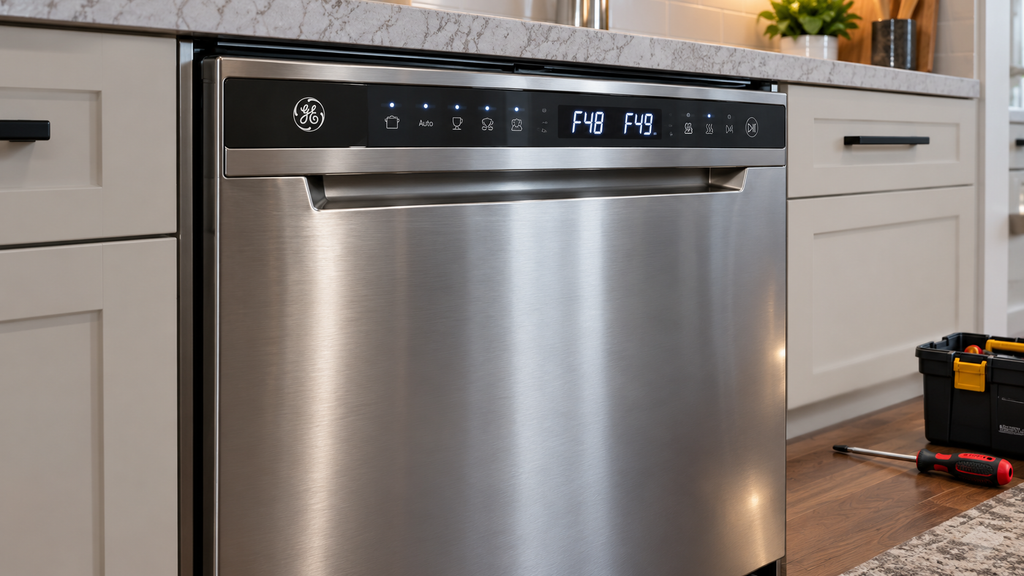
GE dishwasher F48 F49 error codes report a turbidity sensor fault: F48 means the sensor reads the water as dirtier than expected and F49 means it reads cleaner than expected. Filmed or scaled sensor lenses are the most common cause, followed by a corroded harness and a failed sensor. Cut power, clean the lenses, and test the sensor for about 10 kilohms. A replacement sensor costs $30 to $70.
GE dishwasher codes F48 and F49 concern the turbidity sensor on the design described here. Film on its lens, poor connections, or a failed sensor can affect the water reading, so cleaning and wiring checks belong ahead of replacement. This guide follows that diagnosis and explains how to verify the repair after the sensor area is reassembled.
Quick Facts
| Detail | At a Glance |
| Difficulty | Easy to Moderate |
| Time | 20 minutes for cleaning, 45 to 60 minutes for a sensor swap |
| Tools | Multimeter, Torx T20 screwdriver, soft cloth or cotton swabs, white vinegar, towels |
| Part Cost | $0 for cleaning, $30 to $70 for a turbidity sensor |
| Skill | Beginner for cleaning, intermediate for testing and replacement |
What Do the GE Dishwasher F48 F49 Error Codes Mean?
GE dishwasher F48 F49 error codes concern the turbidity sensor on the covered design; lens film, bad connections, or a failed sensor can affect its reading.
The following details help narrow the decision.
| Condition or Detail | Meaning or Next Consideration |
| F48 turbidity sensor high reading cloudy water | it should be clear |
| F49 turbidity sensor low reading clear | soil is expected |
Codes identify a circuit or condition that needs attention; they do not prove which part must be ordered. Similar-looking codes can mean different things across model generations. The spacing and order of the letters and digits also matter.
What Causes a GE Dishwasher to Show F48 or F49?
Turbidity means how cloudy the water is; the sensor uses light to judge that cloudiness. A coated lens can distort its view even when the electrical reading seems normal. That is why the lens condition and the resistance test answer different parts of the diagnosis.
The following details help narrow the decision.
| Condition or Detail | Meaning or Next Consideration |
| film or mineral deposits on the sensor lenses | Judge the sensor signal under the correct temperature and test conditions. |
| loose or corroded harness pins | An interrupted connection can prevent a sound part from working. |
| failed LED or receptor in the sensor | Judge the sensor signal under the correct temperature and test conditions. |
| control board | Consider this after the related parts and wiring have been ruled out. |
A symptom points toward a system, but several parts in that system may cause it; the useful question is which observation separates those parts. Visible damage gives stronger evidence than a guess from age alone. An electrical fault needs a reading made at the right points.
What would make this part a poor choice? A sound test result means you need to consider the other causes before ordering it.
Do F48 and F49 Point to the Heating Element or Thermistor?
These signs need to be read together; a single symptom can point to more than one cause, so the condition of the related parts matters too.
Keep these points in mind.
- Heater faults show as F97 and thermistor faults as F50 and F51
- The turbidity sensor shares the sump but is a separate part
- How to tell the codes apart
A symptom points toward a system, but several parts in that system may cause it; the useful question is which observation separates those parts. Visible damage gives stronger evidence than a guess from age alone. An electrical fault needs a reading made at the right points.
Should I Cut Power to the GE Dishwasher to Reset the Code?
Follow these steps to check this part of the fault.
Check the Reset and Response
- Turn the breaker off for 60 seconds.
- Restore power.
- Clear the code history in service mode.
- Run a normal cycle with a lightly soiled load.
The Off button is a control setting, not a way to remove electrical power from every internal part; a resistance test belongs on a disconnected circuit. Water and nearby powered parts make careless access especially risky. A live reading is a separate task with different hazards.
How to Clear the F48 or F49 Code on a GE Dishwasher Step by Step
Follow these steps to complete the covered procedure for GE dishwasher F48 F49 error codes.
Phase 1: Cut Power and Inspect the Sensor Harness
- Disconnect power.
- Find the sump sensor.
- Unplug its harness.
- Inspect the wires and pins.
- Repair loose connections.
Phase 2: Test the Turbidity Sensor Resistance
- Measure the sensor for about 10 kilohms.
- Reconnect it and retest after a wiring repair.
Phase 3: Clean the Sensor Lenses
- Clean the lenses with a soft cloth or swab.
- Use vinegar for deposits without scratching the lens.
- Rinse completely and dry it.
Phase 4: Replace the Sensor With a Quarter Turn and Retest
- Drain and dry the sump.
- Turn the sensor counterclockwise a quarter turn.
- Disconnect its harness.
- Fit the new sensor and turn it clockwise to lock.
- Connect the harness until it clicks.
- Run test cycles.
What Reading Should the Turbidity Sensor Show?
Use the stated test condition as well as the reading; a normal value at the wrong temperature or terminals can lead to the wrong conclusion.
Keep these points in mind.
- About 10 kilohms across the sensor
- OL means open
- Near zero means shorted
- A sensor that reads correctly but still codes points to lens film or the board
Resistance is measured in ohms with the part disconnected from power; a kilohm is 1,000 ohms. Continuity means there is an electrical path through the tested part. OL usually means that path is open or beyond the meter range.
Should You Clean the Sensor, Replace It, or Call a Technician?
Choose the repair that matches the confirmed fault; a cheaper part will not help if it belongs to a different part of the system.
Keep these points in mind.
- Cleaning free and 20 minutes
- Sensor $30 to $70 and an hour
- Control board $150 to $300 last
- Call a technician when a new sensor still codes
- The sump leaks
- Or the unit is under warranty
A low-cost part is a good choice only when it corrects the confirmed fault; cleaning can solve a blockage, but it cannot repair a cracked housing or an open winding. A control board should come later in the diagnosis because a bad connection can create the same symptom. Parts cost is only part of the decision.
FAQ
Can the Dishwasher Still Wash With F48 or F49?
A wash may begin, but soil sensing can remain unreliable. The code should be diagnosed before assuming cycle performance is normal.
Why Do the Codes Appear After a Greasy Load?
Grease can coat the sensor lenses and distort the reading. Cleaning the visible film may help when the electrical parts are sound.
Does Rinse Aid Affect the Turbidity Sensor?
Wash additives can affect water appearance. The sensor still needs clean lenses and sound wiring to judge the water correctly.
Clearing F48 and F49 at the Sensor
You have a clearer path when the symptoms, model, and test results agree; focus on the failed part and keep the nearby wiring, mounts, and seals in view. A sound diagnosis helps the repair solve the original problem.
Check the full model number, then choose the compatible turbidity sensor so the cycles run the right length again.