Quick answer
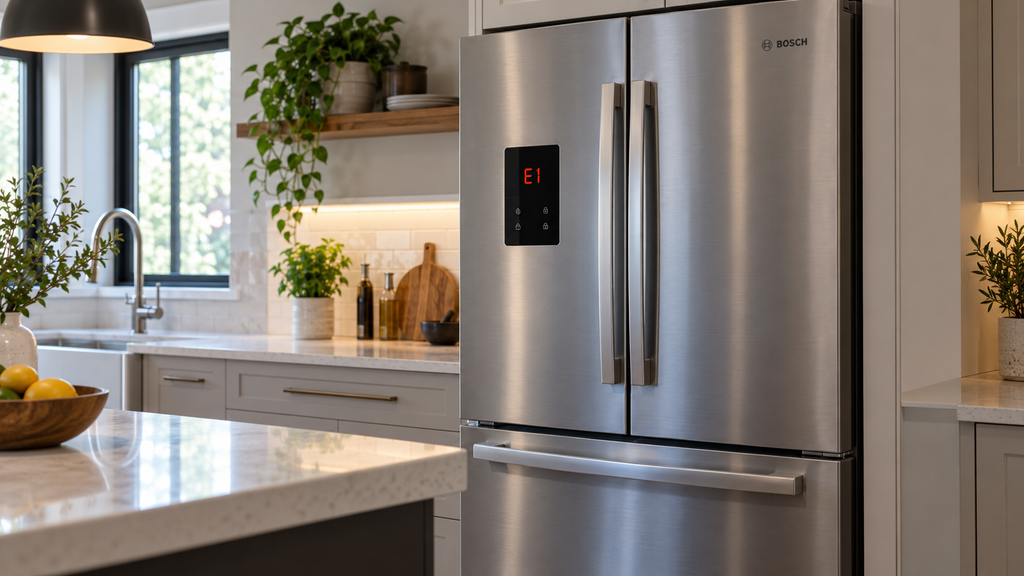
A Bosch refrigerator E1 error code means the main control board is reading the refrigerator compartment temperature sensor outside its expected range. The most likely causes are a failed sensor, a loose or corroded CN11 connector, or damaged sensor wiring. Unplug the fridge for 5 minutes, then test CN11 pins 8 and 12 for about 7.6 kΩ at 68°F. A $20 to $50 sensor fixes most E1 codes.
The Bosch refrigerator E1 error code concerns the refrigerator temperature sensor circuit on the models covered here. The sensor, its wiring, and the relevant CN11 connections need to be checked together because a fault anywhere along the path can affect the reading. The troubleshooting steps below explain how to use the model’s test information before choosing a replacement.
Quick Facts
| Detail | At a Glance |
| Difficulty | Moderate |
| Time | 10 minutes for a reset, 45 to 90 minutes for the sensor test and swap |
| Tools | Multimeter, Torx T20 and Phillips screwdrivers, flashlight |
| Part Cost | $20 to $50 for the sensor, $200 to $400 for the main control board |
| Skill | Intermediate |
What Does the Bosch Refrigerator E1 Error Code Mean?
The Bosch refrigerator E1 error code points to the refrigerator temperature sensor circuit on the covered models; the CN11 connector carries the relevant sensor paths.
Keep these points in mind.
- Refrigerator compartment temperature sensor reading outside its range
- The main control board displays E1
- Cooling may run long or short
What Causes a Bosch Refrigerator to Show E1?
The sensor tells the control how cold the fresh food section is; a wrong reading can affect cooling even though the compressor can still run. Pins for the compartment sensor and defrost sensor are different. Swapping those test points can lead to an incorrect diagnosis.
The following details help narrow the decision.
| Condition or Detail | Meaning or Next Consideration |
| failed NTC sensor | Judge the sensor signal under the correct temperature and test conditions. |
| loose or corroded CN11 connector | An interrupted connection can prevent a sound part from working. |
| pinched or frayed sensor wiring | An interrupted connection can prevent a sound part from working. |
| burn marks on the board | Consider this after the related parts and wiring have been ruled out. |
| main control board | Consider this after the related parts and wiring have been ruled out. |
A symptom points toward a system, but several parts in that system may cause it; the useful question is which observation separates those parts. Visible damage gives stronger evidence than a guess from age alone. An electrical fault needs a reading made at the right points.
What would make this part a poor choice? A sound test result means you need to consider the other causes before ordering it.
How Do You Reset the E1 Error Code on a Bosch Refrigerator?
Follow these steps to check this part of the fault.
Check the Reset and Response
- Disconnect power or trip the breaker for 5 minutes.
- Restore power.
- Press the alarm or lock button per the manual.
- Watch for the code to return within a cooling cycle.
A reset can clear a temporary control state; it cannot remove a physical blockage or repair a broken wire. What happens after the reset matters more than a for a moment normal display. A returning fault suggests that the control is detecting the same condition again.
How to Test and Replace the Temperature Sensor on a Bosch Refrigerator Step by Step
Follow these steps to complete the covered procedure for Bosch refrigerator E1 error code.
Phase 1: Unplug the Fridge, Shut off the Water, and Remove the Rear Cover Plate
- Disconnect power and water.
- Remove the four corner screws from the rear cover plate.
- Remove the plate.
Phase 2: Inspect the Board and Harness, Then Unplug CN11 Without Pulling the Wires
- Inspect the board wires and connections.
- Find CN11 for the refrigerator and CN12 for the freezer.
- Unplug CN11 by its connector, without pulling its wires.
Phase 3: Measure CN11 Pins 8 and 12
- Set the meter to ohms.
- Measure compartment sensor pins 8 and 12.
- Measure defrost sensor pins 6 and 12.
- Compare with about 7.6 kilohms at 68°F or 7.1 kilohms at 77°F for the specified sensor.
Phase 4: Replace the Sensor on the Rear Wall
- Disconnect power and water before changing a sensor.
- Remove food and shelves.
- Release the rear sensor bracket and cover.
- Remove the old sensor from its mount.
- Fit the new sensor firmly against the rear wall.
- Reconnect the harness and lock it.
- Refit shelves.
- Restore water and power.
- Watch cooling for a few hours.
What Should the Bosch E1 Sensor Readings Be?
Use the stated test condition as well as the reading; a normal value at the wrong temperature or terminals can lead to the wrong conclusion.
The following details help narrow the decision.
| Condition or Detail | Meaning or Next Consideration |
| pin pair | Use this observation to narrow the fault before choosing a replacement. |
| temperature | Use this observation to narrow the fault before choosing a replacement. |
| expected kΩ | Use this observation to narrow the fault before choosing a replacement. |
| pass or replace conclusion | Use this observation to narrow the fault before choosing a replacement. |
Resistance is measured in ohms with the part disconnected from power; a kilohm is 1,000 ohms. Continuity means there is an electrical path through the tested part. OL usually means that path is open or beyond the meter range.
What Other Bosch Refrigerator Error Codes Should You Know?
These signs need to be read together; a single symptom can point to more than one cause, so the condition of the related parts matters too.
The following details help narrow the decision.
| Condition or Detail | Meaning or Next Consideration |
| with meaning | Use this observation to narrow the fault before choosing a replacement. |
| first check | Use this observation to narrow the fault before choosing a replacement. |
| and DIY rating | Use this observation to narrow the fault before choosing a replacement. |
Codes identify a circuit or condition that needs attention; they do not prove which part must be ordered. Similar-looking codes can mean different things across model generations. The spacing and order of the letters and digits also matter.
Should You Replace the Sensor, the Control Board, or Call a Technician?
Choose the repair that matches the confirmed fault; a cheaper part will not help if it belongs to a different part of the system.
Keep these points in mind.
- Sensor $20 to $50
- Board $200 to $400
- Technician for burn-marked boards
- Under-warranty units
- Or a fridge over 12 years old
FAQ
Does E1 Point to a Temperature Sensor Fault on a Bosch Fridge?
Yes, E1 concerns the refrigerator sensor circuit on the covered setup. A bad connector can create the same signal as a bad sensor.
When Should You Call a Technician for a Bosch E1 Error?
Call when the sensor and wiring pass but E1 stays active. Service is also sensible when rear board access is difficult.
Will the Fridge Keep Cooling With E1 Showing?
The compressor may run without accurate temperature control. The error display is not a reliable measure of the compartment temperature.
Does E1 Appear After a Power Outage?
It can appear after a power interruption. A code that returns after a reset still calls for a sensor circuit check.
Accurate Temperature Readings Restored
You have a clearer path when the symptoms, model, and test results agree; focus on the failed part and keep the nearby wiring, mounts, and seals in view. A sound diagnosis helps the repair solve the original problem.
Check the full model number, then choose the compatible refrigerator temperature sensor so the E1 code stays cleared.