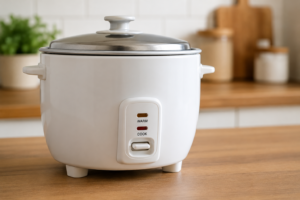
Rice cooker suddenly completely dead, with no lights and no heat? A blown thermal fuse is a likely reason. The fuse is a safety part that cuts power when the cooker overheats, and once it blows, it stays open.
Here is why the fuse blows and how to handle it safely.
This article will teach you:
What the thermal fuse protects
Why it blows
How to test it
When to replace or retire the cooker
Why the Fuse Blows
Overheating from a dirty plate or blocked vents.
A stuck thermostat letting the cooker run too hot.
Running dry without enough water.
Age, since fuses weaken over years of heat cycles.
What You’ll Need
A multimeter
A screwdriver
A matching replacement fuse
How to Test the Thermal Fuse
Unplug the cooker. Never open it while it is plugged in.
Find the fuse. Open the base and locate the small cylindrical thermal fuse in the wiring.
Test continuity. A good fuse shows continuity; an open reading means it blew.
Fix the root cause. Clean the plate and clear vents so a new fuse does not blow again.
Pro Tip: A blown fuse is a symptom, not the disease. If you replace it without fixing the overheating cause, the new fuse will blow too, so always address why it overheated.
If you are not comfortable opening the base and working with wiring, or the fuse blows again after replacement, retire the cooker. A repeat failure signals a deeper fault.