

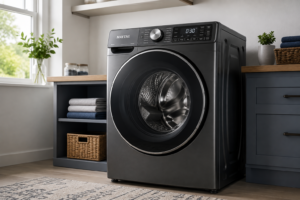
When a Maytag washer lights up but won’t start, power is reaching the control area but the cycle-start path is still being blocked. The procedure checks main-control voltage at the lid-lock circuit first, then tests the lid-lock assembly with continuity and resistance. Careful testing helps.
A powered panel narrows the diagnosis because incoming power already reaches the controls. Common lid switch problems can help explain safety-interlock faults after the control output has been checked. The meter results provide the deciding evidence for both parts.
Tools
Have these items ready before opening the console and testing the lock circuit.
- Multimeter
- 1/4-inch nut driver
- Washer tech sheet
Safety Before the Tests
The first phase uses live AC voltage, followed by de-energized continuity and resistance checks.
- Keep the washer unplugged while covers are removed unless the procedure specifically calls for the live test.
- Perform the live-voltage phase only when energized appliance testing can be done safely.
- Keep meter probes on the named J15 terminals and keep fingers behind the probe guards.
- Unplug the washer before disconnecting J15 for continuity or resistance testing.
- Keep the console supported so it cannot fall onto exposed wiring.
- Use dry hands and a dry work area around the open control area.
- Take a wiring photo before moving connectors when pin positions are difficult to identify.
- Keep children and pets away from the washer while the rear console is open.
- Do not touch exposed terminals during the live test except with the insulated meter probes.
- Stop testing if a connector, terminal, or wire shows heat damage that makes safe probe placement difficult.
What a Lit Control Panel Tells You
Working lights remove several incoming-power causes from the first part of the diagnosis and focus the next checks on the start interlock.
- Incoming power reaches enough of the washer for the display and controls to turn on.
- A failed cycle start can still come from the control output even when the panel appears normal.
- The lid-lock circuit becomes important because the washer needs the correct lock response before the cycle can continue.
- A loose connector at the control or lid-lock path can interrupt the command without turning the whole panel dark.
- Repeated button presses do not provide a clear diagnosis, while the J15 voltage and lock tests provide specific results. Record whether the start command changes any indicator light or produces a click before opening the console.
How to Troubleshoot a Maytag Washer Lights Up but Won’t Start
Follow the control-output test first, then move to the lid-lock checks only when the test result directs that path.
Test the Main Control
- Use a 1/4-inch nut driver to remove the screws from the rear console and harness covers.
- Set the console cover aside.
- Plug in the washer.
- Use the washer tech sheet to enter diagnostic mode and select the manual test.
- Set the multimeter to AC volts.
- Measure connection J15 from the yellow wire at pin 1 to the white wire at pin 3 for about 120 volts AC.
- Press start and read the result. About 120 volts AC means the control output is present. No voltage points to a failed main control. When voltage is present but the lid does not lock, continue to the lid-lock test.
Test the Lid Lock
- Unplug the washer.
- Disconnect the wires at connection J15.
- Set the multimeter to continuity mode.
- Measure between the white and blue wires with the lid closed.
- Open the lid and confirm that continuity is lost.
- When the continuity result changes correctly with lid position, set the multimeter to resistance.
- Measure between the white and yellow wires.
The continuity path should close with the lid closed and open with the lid raised. Resistance between the white and yellow wires should be 85 to 155 ohms. A result outside the expected behavior points to a failed lid-lock assembly. After testing, reconnect the control wiring and secure the rear covers.
Clues That Support a Lid-Lock Fault
These observations can help connect the meter results to the washer’s behavior without adding another procedure step.
- The display accepts selections but the washer does not begin after start is pressed.
- The control sends the expected J15 voltage but the lid does not lock.
- The continuity path fails to change when the lid moves from closed to open.
- The lock winding resistance falls outside the expected range of 85 to 155 ohms.
- The lid-lock connector shows looseness, damaged terminals, or wiring damage after power has been removed.
Checks After the Repair
A short empty-cycle check can confirm that the start interlock now completes its job.
- Reconnect J15 fully and confirm the harness sits away from sharp console edges.
- Reinstall the console and harness covers before normal operation.
- Restore power and select a short empty cycle.
- Press start and confirm that the lid locks and the cycle begins without repeated button presses.
- If the washer still will not begin, other washer start troubleshooting may identify control, wiring, or power-path causes.
Understanding the Two Main Results
The procedure separates the fault by checking control output before the lock itself.
- No expected AC voltage at J15 directs the diagnosis to the main control.
- Expected AC voltage with no lid-lock action moves the diagnosis to the lock assembly.
- Continuity that does not change with lid position points to a failed lock switch path.
- Resistance outside 85 to 155 ohms points to a failed lock assembly after the continuity check passes.
- Correct control output and correct lid-lock readings mean another part of the start circuit needs diagnosis. Related control board issues can provide added electronic context.
Key Takeaways
A Maytag washer with working lights but no cycle start needs a focused check of the control output and lid-lock circuit. The two-phase test separates those areas without replacing parts from the symptom alone.
Once the failed control or lock part is corrected, the lid should respond to the start command and the washer should begin a short empty cycle normally. Clear meter readings make the next repair decision much easier.