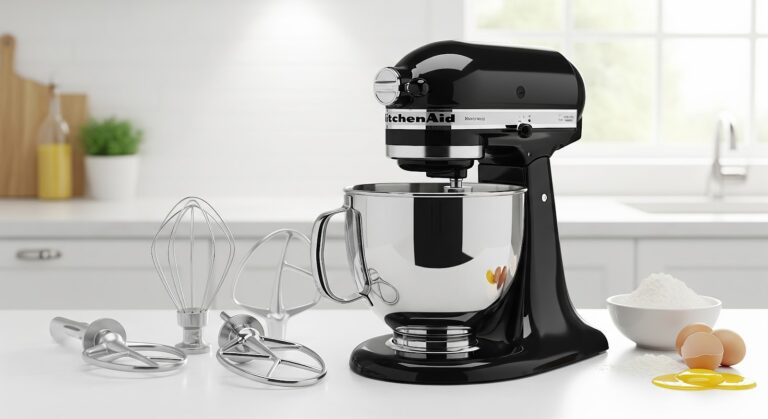
A motor that runs while the beater stays still points toward the attachment shaft, planetary pin, drive parts, or worm gear. KitchenAid stand mixer beater not spinning diagnosis begins outside the housing and reaches the gearbox only after the simple connection checks are complete.
The stand mixer drivetrain can fail at more than one point. Preserving the original check order helps prevent a good planetary or gear from being replaced without evidence.
Mixer worm gear replacement belongs after the beater fit, shaft pin, and planetary have been checked. Opening the gearbox too early can add work while leaving a simple external connection fault untouched.
Clean mixer attachments make the fit easier to inspect. Routine stand mixer care, a broader stand mixer schedule, and model-aware stand mixer information also help separate maintenance needs from drivetrain damage.
Before work begins, the repair area should be photographed in its undisturbed state. That record can show the original position of a connector, fastener, hose, bracket, or cover when reassembly reaches a point that looks uncertain.
The final test should answer the complaint that led to the KitchenAid stand mixer beater not spinning. A short, controlled test limits strain on the serviced appliance and gives the repair area time to reveal looseness, leakage, noise, heat, or poor movement before normal use resumes.
Common Causes of a Stationary Beater
Stand mixer planetary repair may be needed when the shaft pin or planetary connection is damaged, while a drive belt or gear fault can interrupt power farther inside.
- A loose or poorly seated attachment may not engage the beater shaft correctly.
- A missing or damaged shaft pin can disconnect the planetary from the center shaft.
- A worn planetary hole can allow movement without reliable drive transfer.
- A stripped worm gear can let the motor run without turning the beater.
- Broken internal teeth can create shavings, noise, or intermittent motion.
Tools and Parts
Gather the following items before the cabinet or housing is opened.
- Phillips screwdriver
- Flathead screwdriver
- Needle-nose pliers
- Clean shop towels
- Soft brush
- Food-safe mixer grease
Safety
- Unplug the mixer before removing a cover, brush cap, planetary part, or wire connection.
- Work on a clean, dry counter with enough room to keep screws and small parts organized.
- Support the heavy mixer body with both hands whenever it is turned on its side or upside down.
- Keep food, bowls, and ingredients away from exposed grease, carbon dust, and electrical parts.
- Wear eye protection when brushing debris or using compressed air around the gearbox.
- Use only food-safe grease approved for stand-mixer gear cases.
- Stop if a wire is burned, insulation is cracked, or a winding test requires procedures beyond the available service data.
How to fix a non-spinning KitchenAid stand mixer beater
Follow these steps for KitchenAid stand mixer beater not spinning while keeping every removed fastener and connection organized.
Check the Attachment and Planetary
- Plug the mixer into a working outlet, run it briefly, and listen for the motor. Motor sound with no beater movement points toward the drivetrain.
- Unplug the mixer, remove the beater, inspect the attachment shaft pin and beater opening for damage, reattach the beater correctly, and test again.
- Inspect the gap, movement, and free play around the planetary. Note any wobble or unusual rotation before taking it apart.
- Place the unplugged mixer upside down on a towel, push out the planetary retaining pin, and slide the planetary from the center shaft.
- Inspect the retaining pin, shaft, and planetary hole. Replace a damaged part, reassemble and test, then continue to the gearbox only if the beater still does not turn.
Open and Repair the Gearbox
- Remove the rear cover screws, side housing screws, and top cover to expose the gearbox.
- Inspect the worm gear for shavings, rounded areas, and missing teeth.
- Scrape away the old grease, wipe the case and gears, and remove loose debris.
- Remove the retaining clip, slide off the old worm gear, align the replacement, and reinstall the clip.
- Pack food-safe grease around the gear teeth and moving surfaces until the case has about 90 percent coverage.
Reassemble and Test the Drive
- Return the housing, rear cover, and planetary, then plug in the mixer and test every speed for steady beater movement.
Symptoms That Narrow the Failure
Observation can separate an attachment issue from a planetary or gearbox fault.
- A beater that slips off the shaft supports inspection of its mounting opening and retaining pin.
- A planetary that wobbles supports a shaft, pin, or planetary-hole inspection.
- Motor sound with no planetary motion supports a drivetrain problem inside the housing.
- Grinding with intermittent motion supports damaged gear teeth and loose debris.
- Oil around the shaft supports inspection of the center shaft O-ring during disassembly.
- A silent machine belongs with a stand mixer diagnosis before drivetrain work begins.
Common Repair Mistakes
Correct handling protects the new gear and keeps the planetary aligned.
- Testing with power connected before covers are installed exposes moving and electrical parts.
- Forcing the planetary pin can bend it or enlarge its mounting hole.
- Leaving old shavings in the gearbox can damage fresh grease and replacement teeth.
- Installing the retaining clip incompletely can let the worm gear move on its shaft.
- Ignoring a loose planetary assembly part can leave the original motion problem in place.
- Using unapproved lubricant conflicts with proper stand mixer care and can contaminate the gear case.
Care After the Repair
A light first use and routine inspection can protect the serviced drivetrain.
- Run every speed without a load and listen for clicking, grinding, or speed changes.
- Start the first recipe with a small, soft mixture instead of dense dough.
- Confirm that the beater remains secure and clears the bowl correctly.
- Clean the mixer attachments parts after use so dried food does not affect fit.
- Store the stand mixer on a stable surface where the planetary will not be struck.
- Follow a regular stand mixer schedule so grease, shavings, or new wobble are noticed early.
Related guides
To Wrap Things Up
A stationary beater can come from a simple attachment fit or a damaged part inside the drive. Checking the shaft and planetary first keeps the gearbox work tied to clear evidence.
Smooth movement at every speed and a quiet light-load test show that power is reaching the beater again. Routine cleaning and prompt attention to wobble can help the repair last.
The last step is the part itself: match a mixer parts to your model number rather than to a photo or a part name.