Start with the main clue. A bad magnetron runs the microwave with no heat, often with a loud hum or burnt smell, but the diode and a door switch cause the same symptom and cost less, so they get tested first, after the capacitor is discharged. This guide explains how to tell if microwave magnetron is bad with observations first, model-specific checks second, and a part decision only after a repeatable result. That order keeps a free correction from turning into an unnecessary part order and gives a homeowner a clear point to stop when the work moves beyond safe DIY testing.
Signs of a Bad Magnetron and What They Do Not Prove
These checks help narrow how to tell if microwave magnetron is bad without buying the first part that seems possible.
- Runs, no heat.
- Loud buzz or hum.
- Burnt smell.
- Arcing or sparks in the cavity.
- Blows the fuse.
- Each sign shared by diode, capacitor or door switch.
Repeat any surprising result once. Confirm the meter setting, disconnect the required wire, and use clean probe contact before treating the result as final.
Quick Diagnosis Table
| Symptom detail | Likely cause | Part to check | Test |
| No heat and normal sound | Diode or interlock fault | Diode and door switches | Diode mode and switch continuity |
| No heat with a loud hum | High-voltage fault | Diode, capacitor, or magnetron | Diode first, magnetron last |
| No heat with a burnt smell | Overheated high-voltage part | Magnetron or diode | Visual check after safe discharge |
| Sparks in the cavity | Waveguide cover, food residue, or magnetron antenna damage | Cavity parts and magnetron | Stop use and inspect |
| Fuse blows when Start is pressed | Shorted high-voltage or interlock part | Diode, capacitor, or switch | Professional diagnosis if untrained |
| Runs briefly, then stops | Thermal or control protection | Switch, thermostat, or magnetron | Switch test and service data |
Use the table as a starting point, not as proof. More than one fault can create the same symptom, so the next section narrows the result with an inspection or meter reading before any part is ordered.
The Stop Line: Who Should Not Open a Microwave
These checks help narrow how to tell if microwave magnetron is bad without buying the first part that seems possible.
- The capacitor can hold a lethal charge after unplugging.
- No discharge tool or no confidence means stop.
- Unit under warranty.
- Cost of the part versus the unit, link M03.
Repeat any surprising result once. Confirm the meter setting, disconnect the required wire, and use clean probe contact before treating the result as final.
Verify Your Model First
The model tag on a microwave is on the inside edge of the door frame, on the back of the cabinet, or under an over-the-range unit behind the grease filters. The same part name (magnetron, high-voltage diode, door switch) has several part numbers by model because wattage, mounting and terminal style change between models.
A matching photo is not enough. Compare the connector, mounting points, electrical rating, and any revision suffix with the model-specific listing.
Safety
- Unplug.
- Discharge the capacitor before touching anything.
- Insulated tools and rubber gloves.
- Never touch the magnetron’s antenna or ceramic.
- Never run the unit with the cover off.
- Keep the meter leads on the part only.
Tools
- Multimeter
- Insulated screwdriver
- 10K ohm 5 watt resistor with alligator clips
- Rubber gloves
- Torx screwdriver
- Flashlight
How to Discharge the Capacitor and Test the Diode, Door Switches and Magnetron
Discharge the Capacitor
- Unplug the microwave.
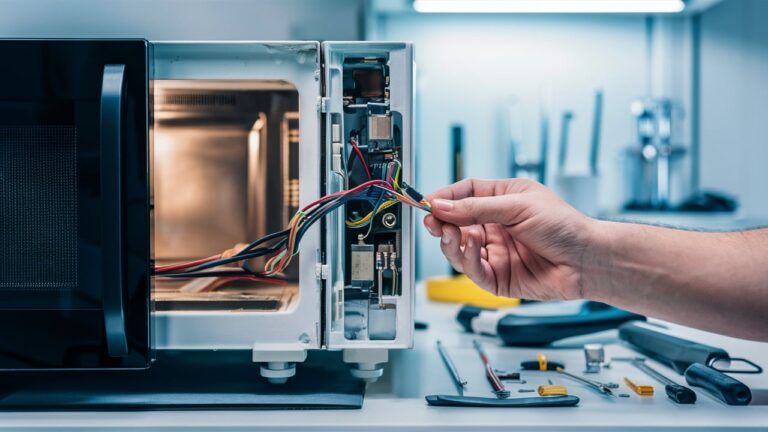
- Remove the outer cover to expose the internal parts.
- Locate the high-voltage capacitor near the magnetron and diode.
- Hold an insulated screwdriver only by its insulated handle and bridge both capacitor terminals.
- Expect a possible pop or small spark as stored energy is released.
- Set the meter to DC volts and confirm zero volts across the terminals.
- For the resistor method, attach alligator clips to both ends of a 10K-ohm, 5-watt resistor.
- Connect the clips across the capacitor terminals.
- Wait about 30 seconds.
- Confirm zero volts with the meter before touching any internal part.
Test the High-Voltage Diode
- Set the multimeter to diode mode.
- Place the red lead on the anode and the black lead on the striped cathode.
- Expect about 0.5 to 0.8 volts in one direction.
- Reverse the leads and expect OL.
- Replace the diode when it reads in both directions or in neither direction.
Test the Door Switches
- Set the meter to continuity.
- Remove one door switch from its bracket.
- Place a probe on each required switch terminal.
- Press and release the switch button. Continuity should change state.
- Replace a switch whose reading does not change.
Test the Magnetron
- Set the meter to resistance and disconnect the magnetron.
- Probe the two filament terminals and expect less than 1 ohm.
- Probe each terminal to the metal magnetron body.
- Replace the magnetron when the filament is open or either terminal has continuity to the body.
Filament open or shorted to the body? Find the exact magnetron for your model number.
What the Result Means and Which Part to Order
These checks help narrow how to tell if microwave magnetron is bad without buying the first part that seems possible.
- Diode fails = high-voltage diode.
- Switch does not toggle = door switch.
- Filament open or shorted to body = magnetron.
- All pass, no heat = capacitor or transformer, technician territory.
Repeat any surprising result once. Confirm the meter setting, disconnect the required wire, and use clean probe contact before treating the result as final.
Magnetron Replacement Cost and How Long Should a Magnetron Last
These checks help narrow how to tell if microwave magnetron is bad without buying the first part that seems possible.
- Part band.
- Unit price comparison.
- Typical lifespan band.
- When the answer is a new microwave.
Repeat any surprising result once. Confirm the meter setting, disconnect the required wire, and use clean probe contact before treating the result as final.
When to Stop and Call a Professional
- Stop when live-voltage testing is required and safe meter work is unfamiliar.
- Stop when wiring, terminals, or insulation show heat damage.
- Stop when the procedure or connector layout does not match the model documentation.
- Use professional service for sealed-system refrigerant work, repeated breaker trips, or a repair that requires unsafe lifting.
FAQ
How do I test a magnetron?
Use the checks in this guide for how to tell if microwave magnetron is bad, then compare the result with the model’s technical sheet. Replace a part only after its own test fails.
Is it worth replacing?
It is often worth fixing when testing identifies one ordinary service part and the appliance has no major leak, bearing, cabinet, or control problem.
How long should a magnetron last?
Service life varies with use, water quality, airflow, loading, and maintenance. A meter or inspection result is more useful than age by itself.
Can I fix it myself?
Start with the free observation named in the table, then follow the tests in order. The first clear failed result identifies the next repair decision.
Conclusion
A microwave that runs without heating does not automatically need a magnetron. Door switches and the high-voltage diode can create similar symptoms, and both should be evaluated before the most expensive part becomes the leading suspect.
If safe testing confirms the diode, homeowners can shop high-voltage diode parts for your model and verify the terminal style and rating. Magnetron, capacitor, and transformer work carries lethal stored-voltage risk and is best left to a qualified technician.