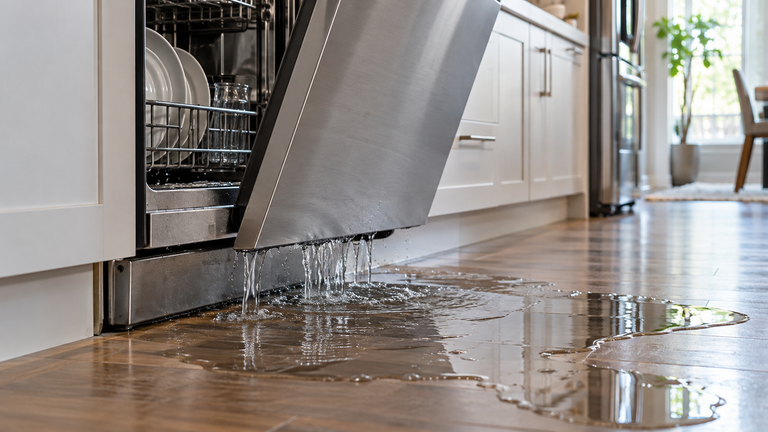
Quick answer
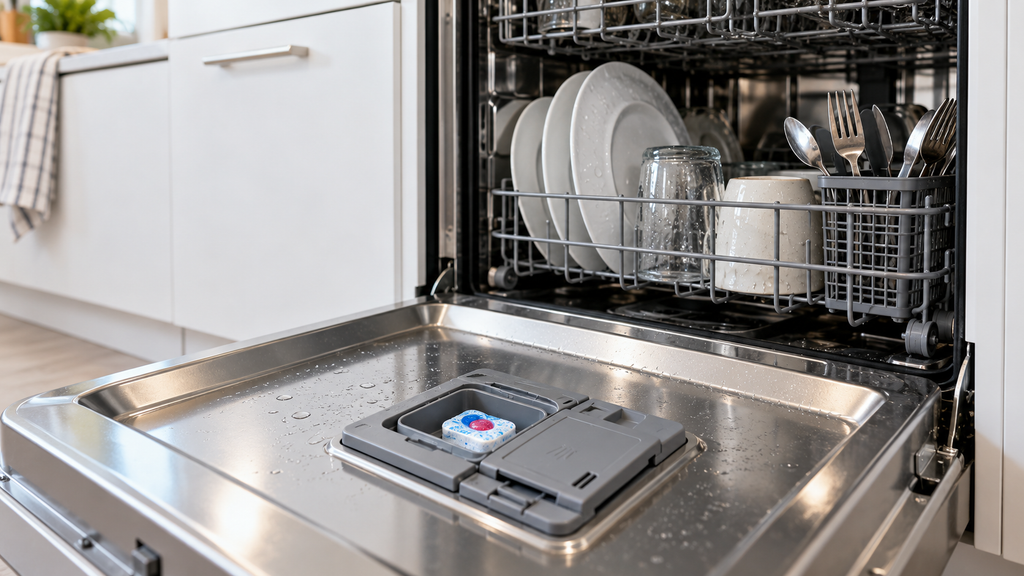
A dishwasher not dispensing detergent most often has a dispenser door blocked by a tall dish or rack handle, a failed wax motor that never releases the latch, or a clogged lower spray arm that cannot wash the cup out. First check whether the door opened at all after the cycle. Then test the wax motor for continuity. A replacement dispenser costs $45 to $110 and takes about 45 minutes.
Detergent left in the cup after a dishwasher cycle has two main diagnostic paths. A closed dispenser points toward a blocked door or release fault, while an open cup with residue calls for checks of water temperature, spray action, and detergent condition. This guide explains how to distinguish those cases and choose between cleaning, correcting the load, or repairing the dispenser.
Quick Facts
| Detail | At a Glance |
| Difficulty | Easy to Moderate |
| Time | 10 minutes for loading and cleaning fixes, 45 minutes for a dispenser swap |
| Tools | Toothpick, white vinegar, multimeter, Torx T15 or T20 screwdriver, kitchen thermometer |
| Part Cost | $0 for cleaning, $15 to $40 for a wax motor, $45 to $110 for a dispenser |
| Skill | Beginner for checks, intermediate for the dispenser |
Why Is My Dishwasher Not Dispensing Detergent?
A dishwasher not dispensing detergent needs two paths of diagnosis; a closed cup points toward release or clearance, while an open cup with residue points toward washing conditions.
The following details help narrow the decision.
| Condition or Detail | Meaning or Next Consideration |
| door still closed after the cycle vs door open | detergent left |
A symptom points toward a system, but several parts in that system may cause it; the useful question is which observation separates those parts. Visible damage gives stronger evidence than a guess from age alone. An electrical fault needs a reading made at the right points.
Is a Stuck Dispenser Door, Bad Wax Motor, or Blocked Spray Arm the Cause?
A wax motor uses heat to move a small plunger that releases the catch on some models; others use a different release device. A broken latch needs different treatment from a blocked spray arm. Loading, water warmth, and detergent condition also affect how well an open cup empties.
Keep these points in mind.
- A tall plate or rack handle blocks the door
- Residue glues the latch
- The wax motor never releases the catch
- A clogged lower spray arm cannot wash the cup out
A symptom points toward a system, but several parts in that system may cause it; the useful question is which observation separates those parts. Visible damage gives stronger evidence than a guess from age alone. An electrical fault needs a reading made at the right points.
What would make this part a poor choice? A sound test result means you need to consider the other causes before ordering it.
Why Is My Dishwasher Not Using the Detergent in the Cup?
These signs need to be read together; a single symptom can point to more than one cause, so the condition of the related parts matters too.
Keep these points in mind.
- Door opened but water under 120°F did not dissolve the pod
- The spray pattern was blocked
- Caked powder from humidity
- The cycle was too short
A symptom points toward a system, but several parts in that system may cause it; the useful question is which observation separates those parts. Visible damage gives stronger evidence than a guess from age alone. An electrical fault needs a reading made at the right points.
Why Is My Dishwasher Not Dispensing Detergent Properly?
These signs need to be read together; a single symptom can point to more than one cause, so the condition of the related parts matters too.
Keep these points in mind.
- Partial release from a weak wax motor
- Door opens late in the cycle
- Rinse aid cross-contamination
- The release stage depends on the selected cycle
A symptom points toward a system, but several parts in that system may cause it; the useful question is which observation separates those parts. Visible damage gives stronger evidence than a guess from age alone. An electrical fault needs a reading made at the right points.
How Do I Test the Dishwasher Dispenser Wax Motor?
Follow these steps to check this part of the fault.
Check the Specified Test Conditions
- Turn the breaker off for.
- Open the inner door panel.
- Disconnect power the two wax motor leads.
- Set to ohms and expect a reading in the low kilohm range rather than OL.
- With power restored the plunger should extend during the wash.
- Replace if open or stuck.
Resistance is measured in ohms with the part disconnected from power; a kilohm is 1,000 ohms. Continuity means there is an electrical path through the tested part. OL usually means that path is open or beyond the meter range.
How to Replace a Dishwasher Detergent Dispenser Step by Step
Follow these steps to complete the covered procedure for dishwasher not dispensing detergent.
Phase 1: Cut Power and Remove the Inner Door Panel
- Disconnect power and water.
- Inspect the dispenser housing for cracks and stuck detergent.
- Clean residue from the housing.
Phase 2: Unplug the Dispenser and Release It From the Door
- Disconnect the dispenser solenoid wires.
- Test the solenoid for continuity.
- Inspect the lid spring and hinge pin.
- Inspect the latch for dirt or damage.
Phase 3: Seat the New Dispenser and Reassemble the Door
- Select the model-matched full dispenser if its housing or latch is broken.
- Use the model-specific door panel and mounting instructions for the swap.
Phase 4: Restore Power and Run a Cycle to Confirm Release
- Refit opened covers.
- Restore power and water.
- Run a cycle and check whether the cup opens and empties.
- Arrange control testing if the release device gets no power.
Should You Clean the Dispenser, Replace the Wax Motor, or Replace the Dispenser?
Choose the repair that matches the confirmed fault; a cheaper part will not help if it belongs to a different part of the system.
Keep these points in mind.
- Clean and reload free
- Wax motor $15 to $40 where sold separately
- Full dispenser $45 to $110 when the latch or housing is cracked
- Call a technician only when the control never sends voltage to the wax motor
A low-cost part is a good choice only when it corrects the confirmed fault; cleaning can solve a blockage, but it cannot repair a cracked housing or an open winding. A control board should come later in the diagnosis because a bad connection can create the same symptom. Parts cost is only part of the decision.
FAQ
Can Detergent Pods Be Placed in the Tub Instead of the Cup?
Use detergent placement intended for the product and wash cycle. A pod in the tub may dissolve before the stage when detergent is needed.
Does Hard Water Stop the Dispenser?
Mineral residue can affect the latch or wash performance. Hard water alone does not prove that the release device has failed.
How Hot Should the Water Be for the Detergent to Dissolve?
The inlet target stated here is 120°F. A sound release mechanism still needs adequate washing conditions to empty the cup.
Detergent Released and Dishes Clean Again
You have a clearer path when the symptoms, model, and test results agree; focus on the failed part and keep the nearby wiring, mounts, and seals in view. A sound diagnosis helps the repair solve the original problem.
Check the full model number, then choose the compatible detergent dispenser or wax motor so the detergent releases on every cycle.