

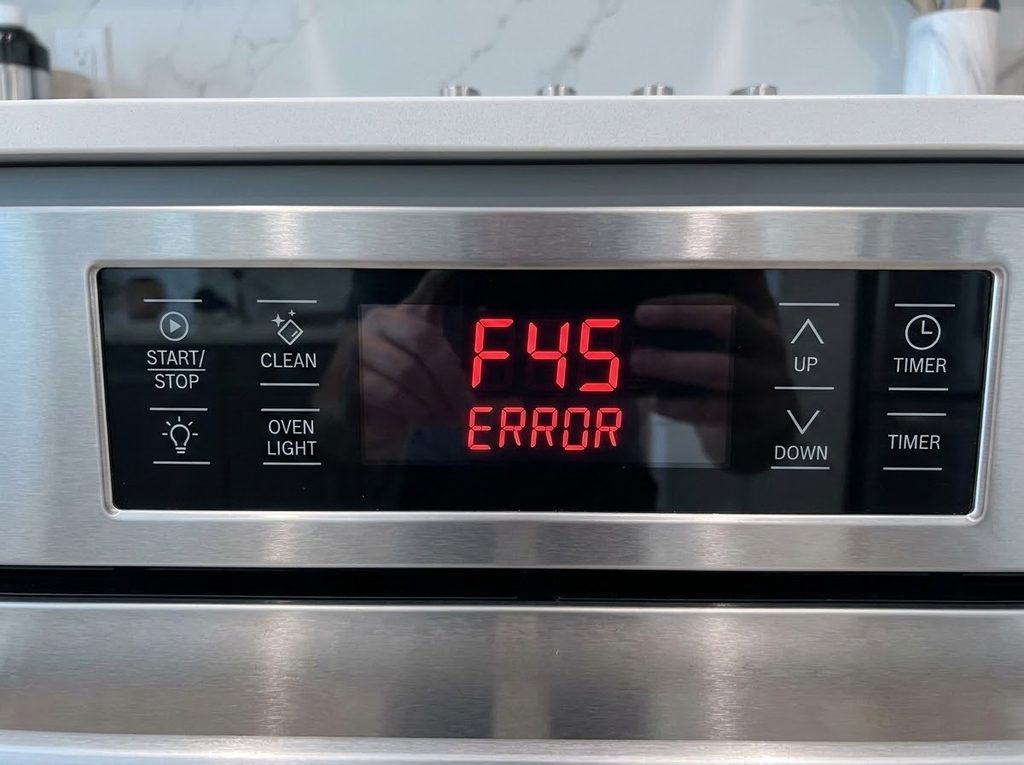
A Bosch double wall oven may display F45 when its upper door latch sends conflicting position signals. On the source model, the control sees the locked and unlocked switches as active at the same time. A Bosch oven F45 error can prevent self-clean from starting and may affect normal latch operation. The fault points to a circuit that needs testing, not automatically to a failed control board.
The source procedure checks the switch harness at board connector P4, tests both switches, looks for shorted wires, and only then considers the power board. Connector names and code meanings should be confirmed in the exact oven model’s technical sheet.
Why the Latch Status Matters
The upper oven uses a motorized latch during self-clean. Two switches report when the latch is locked or unlocked. The control needs a consistent signal before it can manage a high-heat cycle. Conflicting signals can arise from several places:
- A loose harness connector.
- A bent or corroded pin.
- Cracked wire insulation.
- A switch with unreliable contacts.
- A short between the two switch circuits.
- A control board that misreads sound inputs.
The list gives the inspection order. A board should be the last candidate because a new board would still receive bad information from damaged wiring.
Safety Before Opening the Oven
- Turn off the oven circuit breaker before removing panels or connectors.
- Let both oven cavities cool fully.
- Keep the upper door closed or supported according to the model’s service directions.
- Wear gloves around sharp cabinet edges and latch hardware.
- Photograph plugs and routing before disconnecting them.
- Perform resistance and continuity checks only with power off.
- Leave energized status tests and board work to a qualified oven technician.
- Do not force a locked oven door.
The source proposes moving wires while the oven is powered to expose an intermittent short. That energized test should not be presented as a homeowner step. A technician can use the service procedure and proper equipment if an intermittent fault remains.
How to Troubleshoot a Bosch Oven F45 Error
Work through the latch circuit in sequence. Keep a record of each continuity result so a later board decision rests on evidence.
Inspect the Latch Switch Harness
- Find the upper latch’s locked and unlocked switches near the door lock rods.
- Follow their harness to power-board connector P4 on the source model.
- With power off, remove the harness from P4 and inspect both connector faces for bent pins or corrosion.
- Examine the full accessible wire length for cracked or burned insulation.
- Move each wire gently during a power-off continuity test to look for an intermittent internal break.
- Check continuity end to end and measure across any existing splice or repair.
- Compare every wire position with the model wiring diagram and check that each terminal is secure.
- Reseat the harness in P4 and confirm that its latch holds.
A connector may look fine from a distance but still have a terminal that backs out. Use good lighting and the model diagram rather than guessing which wire belongs in a pin position.
Test Both Latch Switches
- With power isolated, move the latch mechanism as the service instructions permit and listen for each switch click.
- Check continuity while each switch lever moves between its positions.
- Note flickering or unstable readings that could indicate a worn contact.
- Have a qualified technician perform the source’s powered display-status check if needed.
- Remove debris and clean switch contacts with a product approved for the part, keeping liquid away from other electrical components.
- Remove and inspect a suspect switch for contact wear, poor alignment, or corroded terminals.
A click does not prove the electrical contacts work. The meter should show the expected change for the model’s switch design. Replace a switch only after it fails that check or shows clear damage.
Look for a Short Between Status Wires
- Disconnect the harness from P4 with power off.
- Check the pins and switch circuits with a multimeter for unwanted continuity between them.
- Inspect crossing or pinched wire sections for bare copper or damaged insulation.
- Have damaged wire repaired with a proper replacement or approved splice and insulation method. Tape over a nick alone is not a durable repair.
- Leave the source’s energized harness-flex test to a qualified technician when an intermittent short cannot be found with power off.
The control can receive both status signals if insulation lets two circuits touch. Fixing the wire path is more direct than replacing a board that is only reporting the conflict.
Consider the Power Board Last
- Confirm that the harness, switches, and short-circuit checks pass.
- Match a replacement board to the full oven model if a qualified diagnosis identifies board failure.
- Install it according to the service instructions without trapping wires beneath the board.
- Test several controlled lock and unlock cycles after reassembly.
- Use any self-clean confirmation only under the model’s service procedure after latch operation has been verified.
- If F45 remains, inspect the ribbon harness between boards and the display board as the source advises.
Self-clean raises oven temperature substantially, so repeated attempts are not a substitute for a stable latch test. The door should lock and unlock correctly before that mode is used again.
What to Record if the Fault Returns
Useful notes for a repair technician include:
- The full model number and exact F45 display.
- Whether the upper door is physically locked or unlocked.
- Whether the code appeared during or after self-clean.
- The continuity state of each latch switch.
- The condition of connector P4 and its pins.
- Any wire that changed resistance when moved with power off.
- The result of the final lock and unlock test.
These facts can shorten the next diagnosis. They also prevent the same sound part from being replaced twice.
Closing Thoughts
A Bosch oven F45 error on the source model points to conflicting upper-latch signals. Start at the P4 harness, verify both switches, and rule out a short before considering the board. Safe, controlled lock and unlock operation is the meaningful result after repair. If a live test or internal board replacement is needed, a qualified oven technician should finish that work.