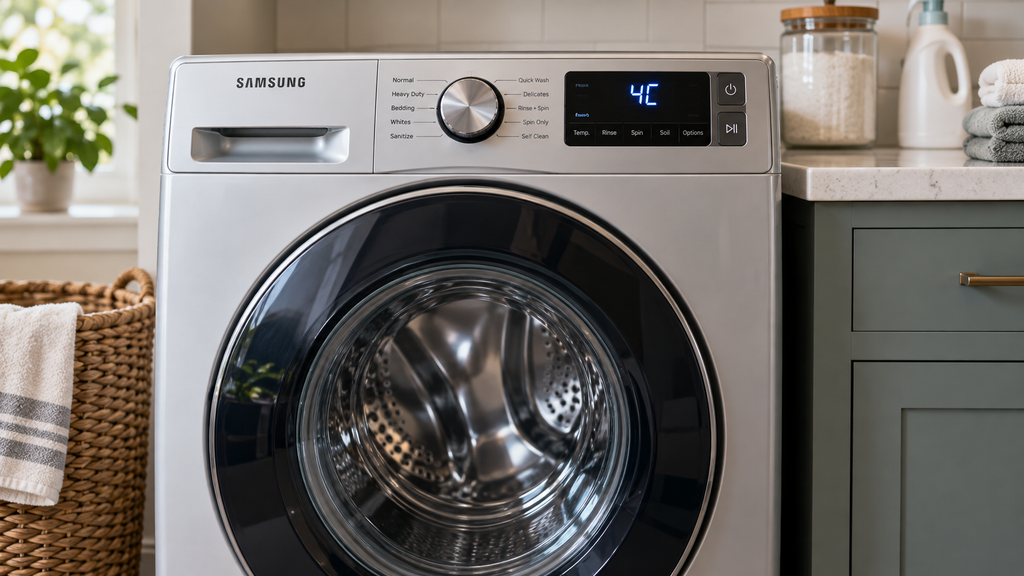
4C means no water supply was detected during the fill window; closed taps and blocked hose screens cause it more often than the valve. This guide explains Samsung washer 4C error code with observations first, model-specific checks second, and a part decision only after a repeatable result. That order keeps a free correction from turning into an unnecessary part order and gives a homeowner a clear point to stop when the work moves beyond safe DIY testing.
Samsung 4E Error and 4C: The Same Code, Two Displays
These checks help narrow Samsung washer 4C error code without buying the first part that seems possible.
- 4E on older displays.
- 4C and 4C2 on newer.
- 4C2 points at hot water on the cold side.
- What the control measures and how long it waits.
Repeat any surprising result once. Confirm the meter setting, disconnect the required wire, and use clean probe contact before treating the result as final.
Code Table
| Code | What it means | What it does NOT prove | Parts implicated | Test first |
| 4C | No water was detected in the fill window | The inlet valve is not proved dead | Supply, screens, valve, level sensor | Open taps and inspect screens |
| 4E | Older display name for the same no-fill condition | The inlet valve is not proved dead | Supply, screens, valve, wiring | Check water flow first |
| 4C2 | Hot water is connected where cold water is expected | A failed control is not proved | Hose routing and supply | Verify hose connections |
| nF | No-fill code on related model families | A universal Samsung part failure is not proved | Supply and inlet system | Use the model code chart |
Use the table as a starting point, not as proof. More than one fault can create the same symptom, so the next section narrows the result with an inspection or meter reading before any part is ordered.
Samsung Washer 4c but Full of Water
These checks help narrow Samsung washer 4C error code without buying the first part that seems possible.
- The fill happened but the level sensor never reported it.
- Pressure hose kinked or full of water.
- Level sensor fault.
- Why replacing the valve cannot fix this branch.
Repeat any surprising result once. Confirm the meter setting, disconnect the required wire, and use clean probe contact before treating the result as final.
Samsung Washer 4c Reset, and What It Proves
These checks help narrow Samsung washer 4C error code without buying the first part that seems possible.
- Power off at the wall for a few minutes.
- A code that returns on the next fill means the cause is still there.
- Brand new Samsung washer 4C is almost always taps or a hose with an aqua-stop that has tripped.
Repeat any surprising result once. Confirm the meter setting, disconnect the required wire, and use clean probe contact before treating the result as final.
Verify Your Model First
The model tag on a washer sits under the lid rim or on the top-back edge of a top-load washer, and inside the door rim or behind the lower kick panel on a front-load washer. The same part name (lid switch, drain pump, inlet valve) has different part numbers by model because connectors, brackets and flow ratings change between models.
A matching photo is not enough. Compare the connector, mounting points, electrical rating, and any revision suffix with the model-specific listing.
Safety
- Unplug.
- Shut both taps.
- Towels under the hoses.
- Hose water is under pressure.
- Keep the meter off live terminals except for the voltage step.
Tools
- Multimeter
- Pliers
- Phillips screwdriver
- Small brush
- Towels
- Flashlight
How to Fix a 4C Code, in the Order That Costs Least
Check the Water Supply
- Remove the fill hoses from the water valve.
- Inspect both hoses for damage, frozen sections, or blockages.
- Clear any obstruction or replace a damaged hose.
Check the Inlet Filters
- Locate the hot and cold inlet filters in the valve ports.
- Inspect both filters for debris or mineral deposits.
- Clean the filters or replace the valve assembly when a filter is damaged.
Check the Wiring
- Remove the six screws that hold the rear control-panel assembly.
- Lift the panel. Use a flat screwdriver to release the side hooks only when needed.
- Inspect the water-valve wiring for damage and loose connections.
- Reseat every loose connection.
Inspect and Test the Water Inlet Valve
- Inspect the hoses from the valve to the dispenser for damage or blockage.
- Clear blocked hoses and replace damaged hoses.
- Inspect the valve body and terminals for visible damage.
- Replace a broken valve or damaged harness.
- Disconnect power and measure each valve coil. Expect about 0.9K to 1.1K ohms on the source model family.
- For the live fill test, check for about 120 VAC at the called valve.
- When the valve and its supply pass but the code remains, continue to the control or level-sensing circuit.
What the Result Means and Which Part to Order
These checks help narrow Samsung washer 4c error code without buying the first part that seems possible.
- Screens blocked = no part.
- Coil open or off range = water inlet valve.
- 120 volts present, valve good, no fill = valve stuck or supply.
- Fills but 4C = water level sensor or its hose.
- No voltage at the valve = control board, link W05.
Repeat any surprising result once. Confirm the meter setting, disconnect the required wire, and use clean probe contact before treating the result as final.
When to Stop and Call a Professional
- Stop when live-voltage testing is required and safe meter work is unfamiliar.
- Stop when wiring, terminals, or insulation show heat damage.
- Stop when the procedure or connector layout does not match the model documentation.
- Use professional service for sealed-system refrigerant work, repeated breaker trips, or a repair that requires unsafe lifting.
- Shut off the water and call for service when a valve, hose, or cabinet leak cannot be contained.
FAQ
Can I fix 4C myself?
Start with the free observation named in the table, then follow the tests in order. The first clear failed result identifies the next repair decision.
Does 4C mean I need a new washer?
Start with the free observation named in the table, then follow the tests in order. The first clear failed result identifies the next repair decision.
How do I fix 4E?
Start with the free observation named in the table, then follow the tests in order. The first clear failed result identifies the next repair decision.
How do I force a reset?
A power cycle or model-specific reset may clear a control state, but it cannot repair an open coil, broken switch, blocked hose, or damaged motor.
Conclusion
A 4C code can come from a closed tap, restricted screen, poor hose flow, or a failed valve, so the free water-supply checks should settle the easy causes first. A failed coil reading or missing flow with proper supply makes the valve the better repair target.
After that result is confirmed, homeowners can shop water inlet valve parts for your model and match the ports, connectors, and mounting pattern. A good valve shifts the next decision to the level sensor, wiring, or control.